Productive Failure: Why Struggling Is How Kids Actually Learn
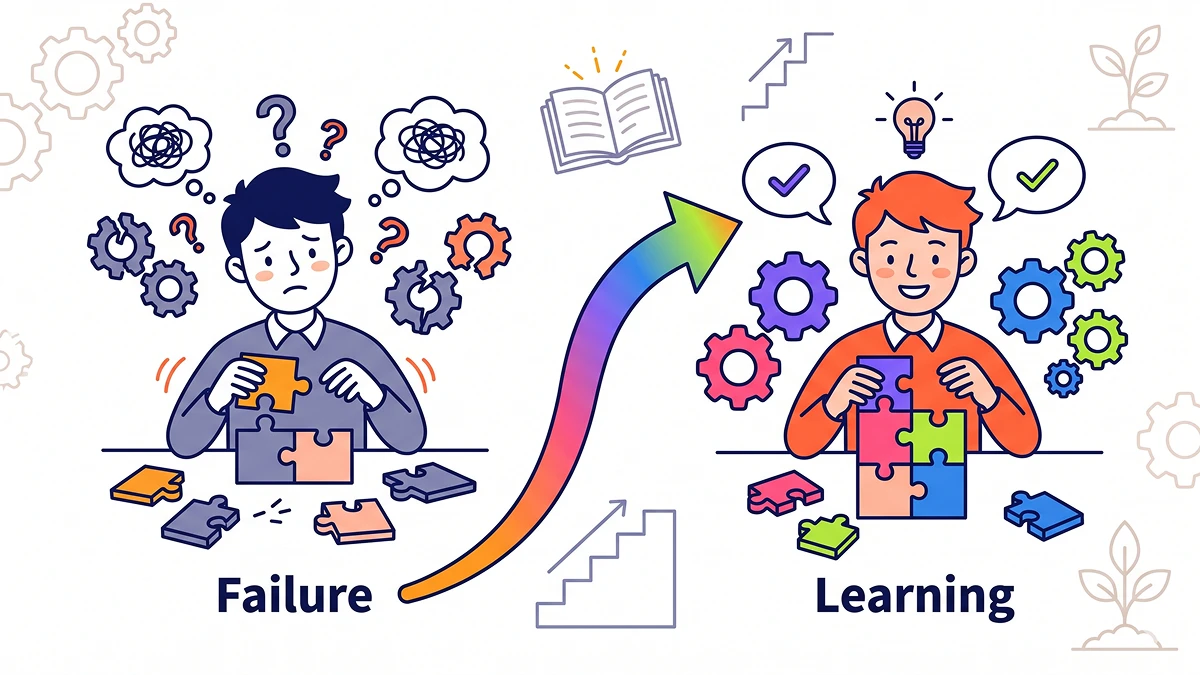
Most parents help their children immediately when they get stuck on a problem. The intention is good. Watching your child frustrated over a math worksheet is uncomfortable, and the fastest way to resolve that discomfort is to explain the answer. But research into the productive failure learning method shows this instinct, however well-meaning, can work directly against learning.
When Charlotte's father signed her up for math classes at Strive, he described their usual homework routine. He'd sit with her at the kitchen table, point to the worksheet, and walk through the exact formula she needed. The homework got done faster. Charlotte seemed happy. They could both move on with their evening. By any surface measure, it was working.
A week later, Charlotte encountered a slightly different problem and froze completely. The knowledge had never actually stuck. Her father's desire to be helpful had, without either of them realising it, removed the most important part of learning.
What Research Shows About Productive Failure
The term comes from the work of Manu Kapur, whose research has reshaped how educators think about instruction. Kapur's finding is counterintuitive: students who attempt a problem without being shown the method first, and who struggle and fail to solve it correctly, learn the underlying concept more deeply than students who receive direct instruction upfront.
This is not an argument for leaving children to flounder without support. Kapur identified specific conditions that make failure productive rather than simply demoralising. For struggle to produce learning, students need relevant prior knowledge to draw on, the ability to generate multiple solution attempts, and a genuine gap between what they currently understand and what the problem requires. If the problem is entirely new with no prior knowledge to connect it to, students disengage. If it's too easy, there's no struggle and no learning gain.
The productive zone is a problem that sits just beyond current understanding but is grounded in what the student already knows.
Why Immediate Help Works Against Learning
When a parent or teacher provides the method before a student has attempted the problem, they remove the one thing that makes new knowledge stick: the struggle to reach it.
The process of attempting a problem, generating possible approaches, hitting the edges of current understanding, and then encountering the correct method creates a cognitive context that makes the new knowledge meaningful. Without that context, a formula is just a thing to memorise until the next slightly different problem appears, and then it disappears.
This is what happened to Charlotte. She had memorised the steps her father showed her, but she hadn't understood why they worked. When the surface features of the problem changed, she had no framework to draw on.
It's worth noting that this same pattern appears in how we learned math at school. A teacher introduces a topic, demonstrates a solution step by step, hands out a worksheet, and corrects mistakes so students quickly arrive at the right answer. We grow up believing that direct instruction is the most effective way to teach, so we carry that expectation into how we parent. The research suggests otherwise.
How Productive Failure Works at Strive
Strive builds this principle directly into both the math and coding curricula.
For Charlotte, that means trying first. Before a teacher introduces a method, she's given a problem to work on using what she already knows. The teacher watches her thinking, asks questions, and guides without giving answers. Only after she's tested her own ideas and felt the limits of her current understanding does the method get introduced. At that point, it answers a question she was already asking.
That sequence is what makes it land.
A week after starting with Strive, Charlotte no longer freezes on a new problem. She knows what to do when she doesn't know what to do: she tries something, notices where it breaks down, and adjusts. That's not just a math skill. It's one of the most transferable capabilities she'll ever develop.
If you'd like this approach for your child, our Strive Math programme is built around exactly this method.