How Computer Games Improve Your Child's Skills
Research shows that computer games improve kids' skills in measurable, cognitive ways, yet most parents' first instinct is to reduce game time rather than understand it. A large analysis from the Adolescent Brain Cognitive Development (ABCD) Study, led by Bader Chaarani and colleagues at the University of Vermont, found that children who played video games for three or more hours per day performed better on tests of working memory and impulse control than children who didn't play at all. These aren't peripheral skills. They underlie academic performance, the ability to sustain focus, and the capacity to hold multiple ideas in mind while solving a problem.
A parent recently brought a familiar concern to our team at Strive. Her son was spending hours on games every weekend, and she worried it was becoming unproductive. But as she described what he was actually doing, a different picture emerged. He wasn't just playing. He was building systems, explaining mechanics to friends, and thinking through strategies that were far from passive. That distinction is more important than most parents realise.
What Research Shows About Gaming and Kids' Skills
Screen time is easy to quantify as hours. What's harder to see is the type of thinking happening within those hours, and that matters more.
Many games require sustained problem-solving, experimentation, and adaptation. Players test an approach, adjust when it doesn't work, and try again without hesitation. The loop of attempt, fail, adjust, and retry is exactly the structure of learning. A child who has spent hours navigating that loop in a game has practised one of the hardest things to teach: the willingness to persist through failure until something works.
The ABCD Study tracked over 2,000 children aged nine to ten. Those who played video games regularly showed measurable advantages in working memory and inhibitory control compared to non-gamers. These cognitive abilities consistently predict outcomes in mathematics, reading, and problem-solving.
How Strive Connects Gaming to Learning
At Strive, we use students' interest in games as an entry point rather than something to compete with.
If a student enjoys gaming, we guide them to build their own and introduce math through coordinates, grid logic, and game structure. If they prefer strategy games, we bring in programming logic through challenges that mirror the systems they already love. The core subject matter stays the same. What changes is the entry point, and that shift changes how willing a student is to engage with difficulty.
Students who previously struggled to stay focused are willing to spend significantly more time on a problem when it connects to something they care about. They become more patient with trial and error, more comfortable experimenting without a clear answer in sight, and less discouraged when something doesn't work on the first attempt. These aren't just motivational effects. They're habits of thinking that carry across every subject.
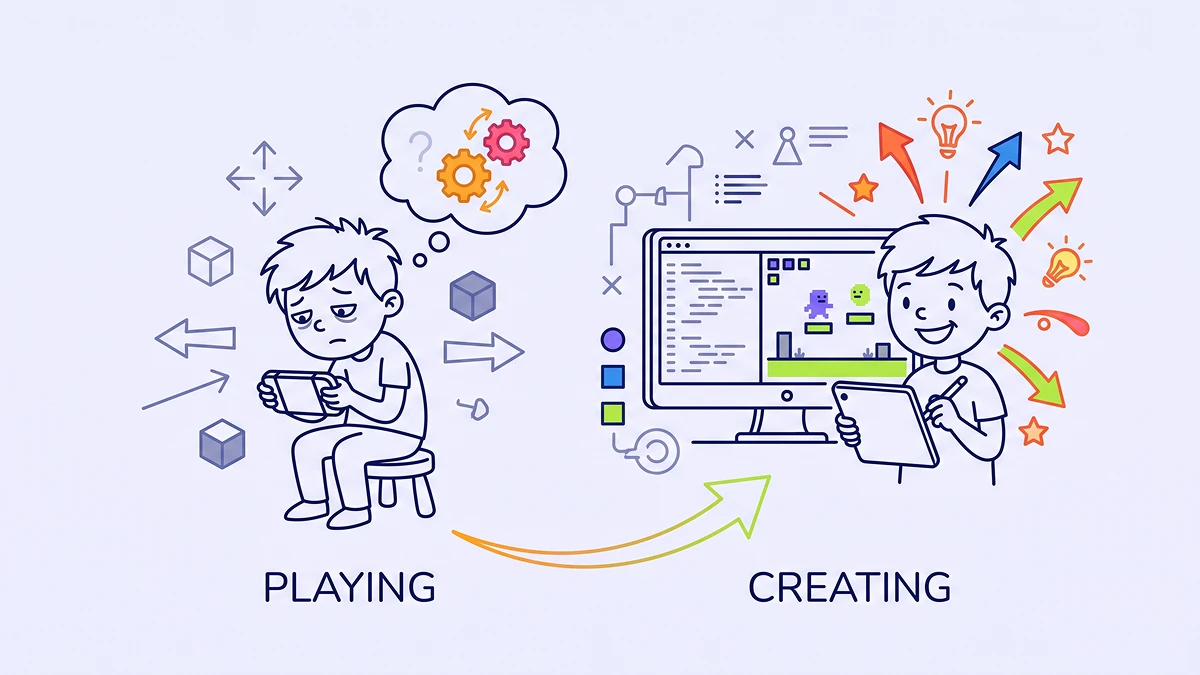
From Playing to Creating
There's a meaningful difference between a child who plays games and one who understands how they work well enough to build one.
The first is consuming a product someone else made. The second is learning to think like a developer: breaking a system into parts, writing logic to handle each one, testing against expected behaviour, and iterating until it works. The transition from one to the other is shorter than most parents expect, and what changes in the process goes well beyond screen time.
If your child is drawn to games, that interest is an asset. The question isn't how to limit it. It's what you build on top of it.
At Strive Coding, students channel their interest in games into building their own: interactive projects, tools, and programs that are genuinely theirs to share. Students who go further progress to AI Coding, where they build production-grade software using the same foundations.